What actually happened
The Information reported on 15 October 2026 that OpenAI has reduced ChatGPT advertising rates and increased its push to attract small and midsize advertisers. The report describes hiring from Meta's advertising business and agencies gradually directing more spend to ChatGPT. One agency compared roughly $5 clicks on ChatGPT with much higher Google costs for particular business-software clients. That is one reported comparison, not an official universal rate card.
Self-serve buying was already available in several countries, including European markets. The new development is lower reported pricing and a more deliberate effort to win smaller advertisers. Rates, minimum budgets, inventory and supported conversion tools can vary by account and format. Ads are visibly separated from ChatGPT's answers and reach eligible users on ad-supported plans, so this is not the same scale or placement mix as established search advertising.
Why a small team cares
Imagine a Spanish consultancy selling a fixed-price CRM migration. It already advertises on Google, but relevant commercial keywords can be expensive. ChatGPT Ads may offer an additional route to people researching CRM choices and implementation options. The consultancy can test one familiar landing page and enquiry form rather than design a new funnel, while identifying which enquiries are genuinely qualified for the service.
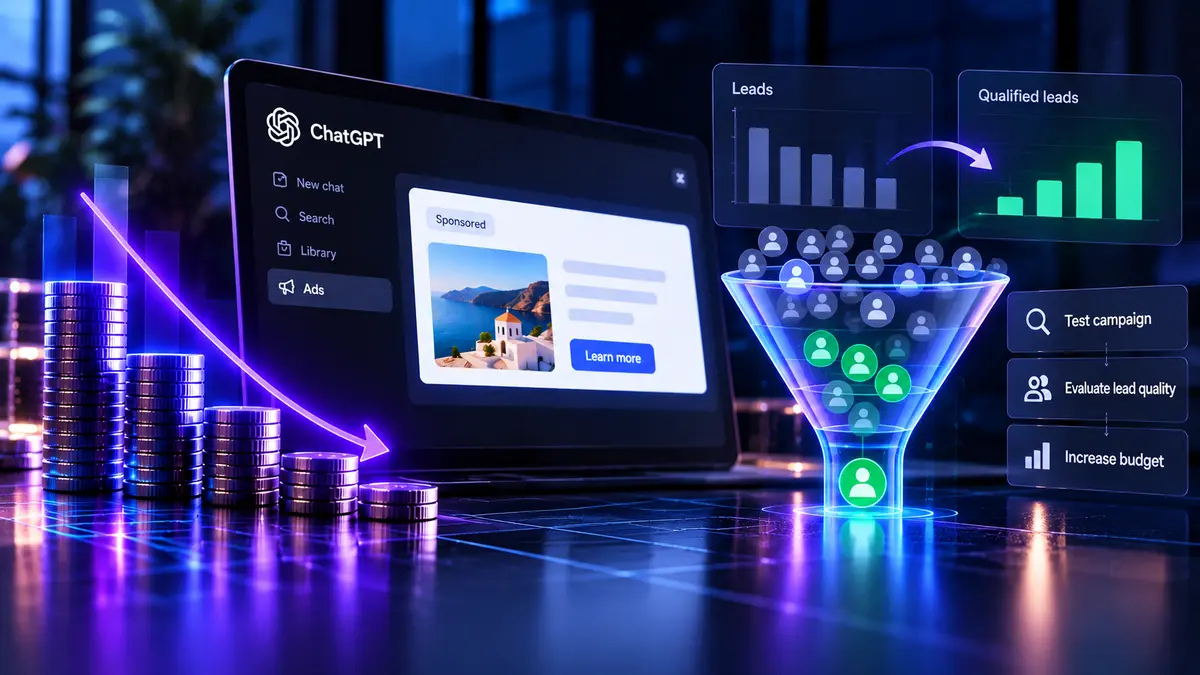
Consider an illustrative campaign with 100 clicks costing €400. Eight people enquire, but only two have the right budget and project scope. The business has spent €200 per qualified lead, not €50, before counting sales follow-up. These figures are an example, not published performance data. A cheaper click helps only when the resulting customers make the acquisition economics work.
Measurement matters because the newer channel has less established performance history and a narrower audience than Google or Meta. Campaign reporting should connect clicks to form submissions, qualified conversations and actual contracts wherever possible. A small budget makes the downside manageable, but only if the business can keep the experiment separate from campaigns that already pay for themselves.
Hype vs useful
Agency examples in The Information suggest ChatGPT advertising can work for some software clients, but they do not give a reliable average for every market. An agency case study with large contract values may have little relevance to a local consultancy. Prices may also rise as more buyers enter the auction. The advertised cost per click is one input in a customer-acquisition calculation, not the business outcome itself.
This is worth testing for advertisers who already know their acceptable acquisition cost and have a landing page that produces leads. Compare a single offer on equal terms, including lead quality and sales results. The opportunity is to discover another profitable source of customers before making a bigger commitment. It is not a reason for a small business without attribution to start spending simply because OpenAI is courting it.