What actually happened
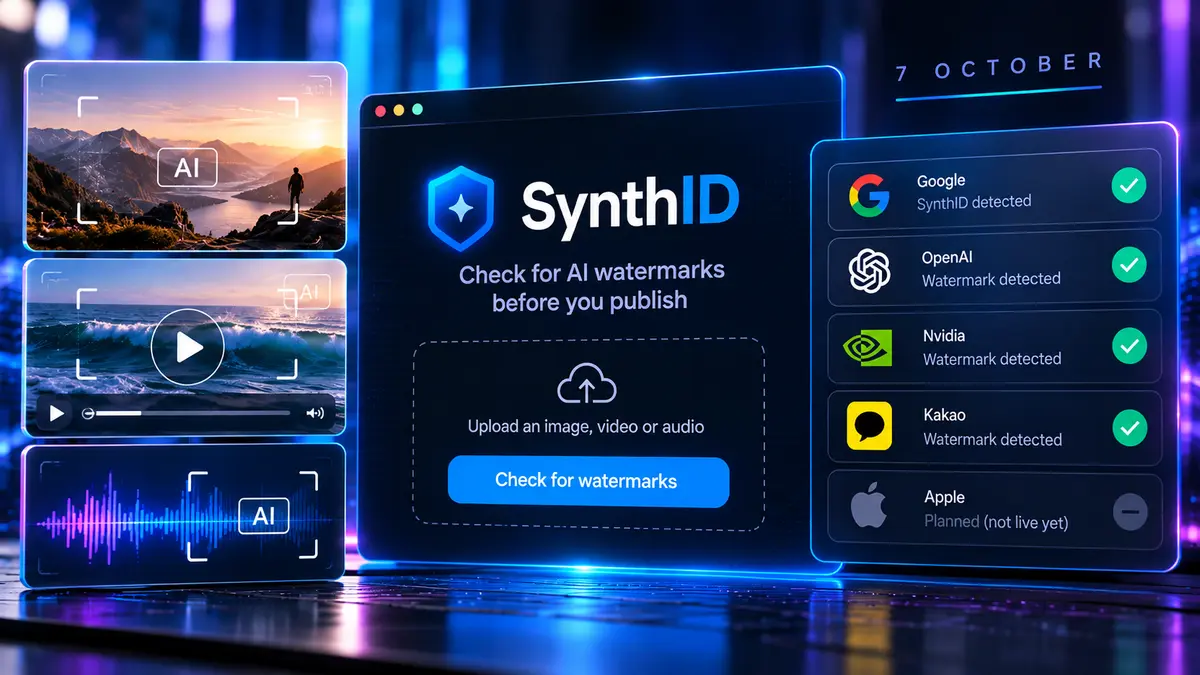
Google opened the SynthID Detector to everyone on 7 October 2026, at synthid.com. It is global and English-only. An earlier version was limited to journalists and media professionals. The public tool checks an uploaded image, video, or audio file for an imperceptible SynthID watermark from Google or partners: OpenAI, Nvidia, and Kakao. Apple is listed as coming soon, not as live coverage.
Sign-in is required, with a Google, Apple, or OpenAI account. Write-ups of the portal privacy notice say uploaded files are processed and deleted after the result, with a short-lived signature kept for quota. Google says it has watermarked more than 180 billion images and videos and about 240,000 years of audio since SynthID launched in 2023. That is Google's count of marked files, not a count of what the public site will catch.
Why a small team cares
A Shopify brand agency taking UGC for a paid ad used to trust the creator's word, or run a guess through Gemini. Gemini's built-in check only sees Google's own mark. OpenAI's verifier only sees OpenAI's. synthid.com is the first public page that reads the partner set in one upload. Before a "real customer" still goes into an ad, that is a two-minute gate. A hit means a major model watermarked the file. Pull it.
Hype vs useful
A clean result is not authenticity. The detector only finds SynthID. It will not catch generators that do not embed the mark, and compression, screenshots, and forwards can weaken the signal. It also will not tell you the file is a real photo of a real customer. Use it as a publish check on one account this week, then keep the human review you already do.
Source: Google (https://blog.google/innovation-and-ai/models-and-research/google-deepmind/synth-id-ai-content/)