What actually happened
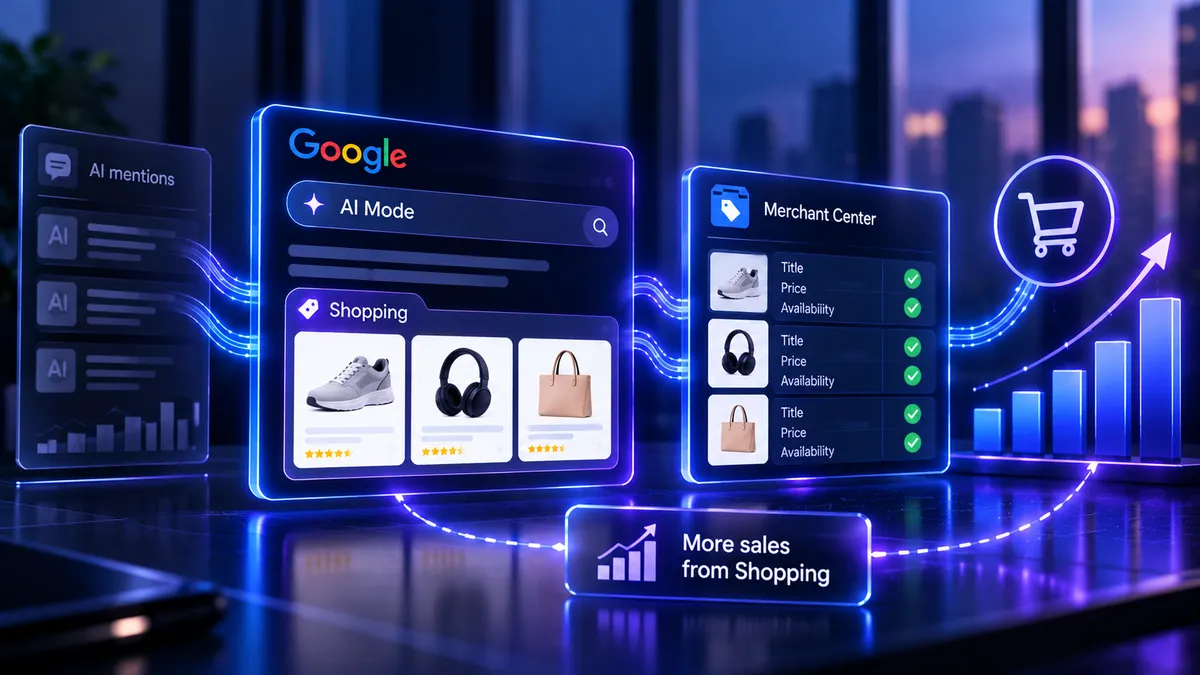
Research from AI visibility company Findrix, reported by Search Engine Land on October 29, found that 57% of links in Google AI Mode's product answers pointed to Google Shopping pages. In 46.5% of those product answers, every link led to a Google-owned page. Those figures describe different measures: the proportion of links and the proportion of answers.
The study collected 55,198 answers across ChatGPT, Gemini and Google AI Mode from 18,400 buyer questions in 35 US product and service categories. Collection took place October 14 to 17, with each question tested once per engine. Fashion and beauty answers had particularly high rates of Google-only links.
The pattern was far less pronounced outside retail. The reporting put Google-owned links at 5.1% for local services and 1.1% for software questions. This is a finding about product discovery, not a rule for every business using AI search.
Why a small team cares
Consider a small clothing retailer whose product descriptions and inventory feed are managed separately. A customer asks AI Mode for a waterproof jacket at a particular price. Google may present a product through its own shopping interface while directing the customer somewhere other than the retailer's organic listing.
That makes product-feed accuracy more consequential. A stale size, incorrect price or missing shipping detail can make a listing less useful right at the point of comparison. Correcting data in Merchant Center is something a small store can do without commissioning a new AI optimization program.
It also changes the reporting question. A brand can be recommended or shown in an AI product answer without generating a click to its website. Website referrals remain commercially meaningful, but they do not describe every shopping discovery event. Merchant Center visibility and actual completed orders belong alongside referral numbers.
Hype vs useful
Findrix measured visible links in generated answers, not clicks, customer choices or purchases. It does not prove that 57% of shoppers went to Google Shopping or that 46.5% of retail sales stayed inside Google's ecosystem.
It is also a US snapshot of particular categories over four days. Individual answers can vary across locations, products, stock levels and repeat runs. Don't use the percentages as your own store's forecast.
For an existing retailer, feed hygiene is the defensible response. If your catalogue is incomplete or inconsistent, improve it now. If it is already clean, monitor product visibility and sales rather than buying a new dashboard merely to count how often an AI assistant mentions your brand.