What actually happened
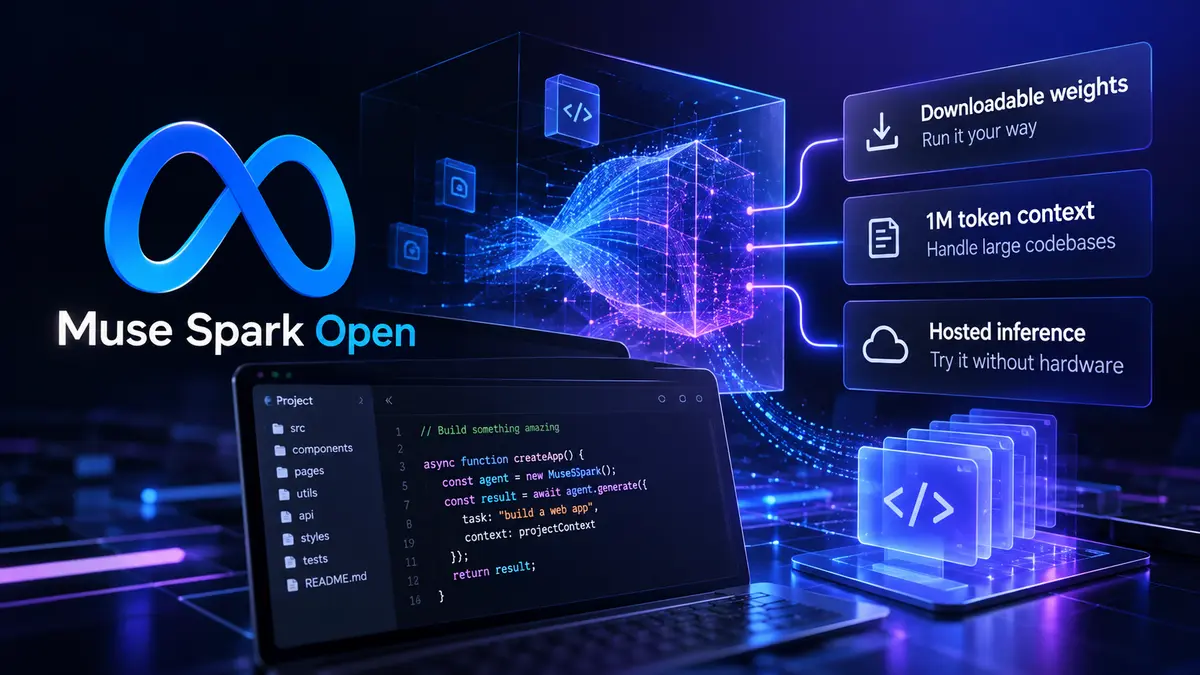
Meta released Muse Spark Open on 15 October 2026. The open-weight mixture-of-experts model has 816 billion total parameters, around 42 billion active per token and a one-million-token context window. It accepts text, images, video and audio, and Meta designed it for coding agents, tool use and multi-step reasoning. Those specifications are documented; its claim to lead US open-weight models is Meta's own performance assessment.
Developers can download weights or use hosted inference through Baseten, Fireworks, Groq, Modal, Nebius, OpenRouter and Together AI. Meta also demonstrated an MLX configuration operating across two M5 Ultra Mac Studios, including fixes and features to the Ice Cubes iOS app and video editing in DaVinci Resolve. That proves an ambitious local deployment is possible, not that buying two computers is an economical choice.
Why a small team cares
Consider a solo developer maintaining a booking application for a local service business. A typical coding-agent assignment involves inspecting multiple files, fixing an availability bug, adding a regression test and running the build. The developer can now send the same task to Muse Spark Open via a hosted provider and evaluate whether it finishes the work as well as the closed model currently in use. That trial needs no new hardware.
For the business, the relevant cost is a successfully delivered feature, not the price of a million input tokens. A lower-cost model may retry tools, miss tests or leave more manual cleanup. The fair comparison includes elapsed time, failed runs, billed tokens and human corrections. The million-token context is useful for inspecting a large repository, but does not guarantee the model will use every detail correctly.
Open weights also create longer-term options for customization and deployment. Running the model on your own systems may give more control over data flows, while a hosted endpoint still processes submitted code under the provider's terms. Those choices have different compliance and operating costs. A small team should make that decision around a recurring workload rather than a headline about hardware compatibility.
Hype vs useful
Meta's published benchmarks and demos are a reason to test, not proof that Muse Spark Open will replace a leading closed coding model in client delivery. Local inference still demands expensive equipment and technical ownership. The weights also come under the Muse Model License rather than unrestricted public-domain terms, so review the commercial and attribution conditions before redistribution or embedding the model in a product.
I see the immediate opportunity in API-level competition. Run one real issue against the current model with identical tests and calculate cost per accepted change. If Muse Spark Open finishes reliably and improves the economics, route a narrow class of jobs to it. Until that evidence exists, switching every agent or building a two-machine inference setup adds work without a proven commercial benefit.