Slack's pitch is interesting because it changes the unit of purchase. Instead of asking how many tokens a team might consume next month, the company wants buyers to think about the cost of giving every employee access to an agent. That is a sensible change in how workplace software is sold. It is not necessarily a saving.
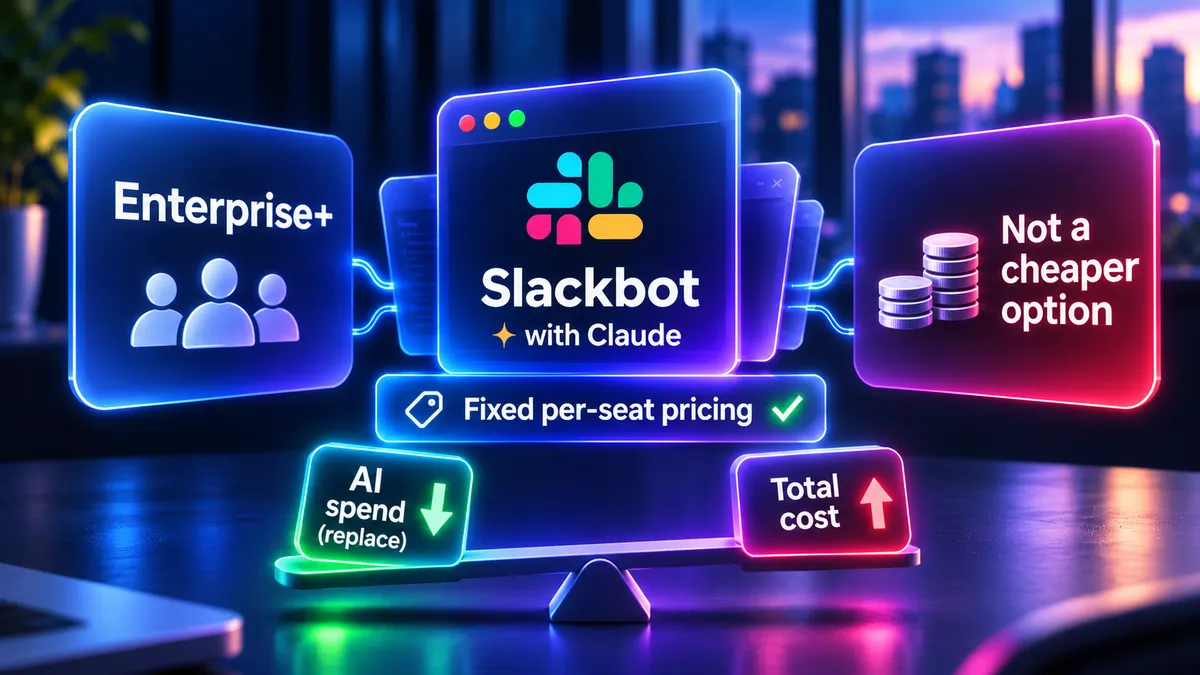
Slack describes its Claude-powered Slackbot as tokenless on Enterprise+. The underlying model still processes tokens, but the customer does not receive a separate bill for each standard Slackbot request under that offer. Other plans, connected third-party AI services and add-ons may have different charging arrangements. Contract and service limits still apply.
Predictable is not the same as cheap
The vendor illustrates the economics with an Enterprise+ price of $540 per employee per year, equivalent to $45 a month. It compares that figure with a survey-based estimate of annual AI spending and advertises potential savings of roughly 75%. That percentage is a hypothetical comparison, not a measured reduction across small agencies. It assumes a substantial amount of existing AI work can move into Slackbot.
Take an agency with ten employees. Its Enterprise+ subscription at the quoted rate would cost $450 a month, or $5,400 a year. Suppose its current Slack subscription costs $150 a month and its separate AI subscriptions cost $200. These are example numbers, not a claim about current Slack plan pricing. The combined bill is $350. Even if Slackbot replaces every separate AI subscription, the new bill is $100 higher each month. If specialized tools remain necessary, the gap gets bigger.
The equation changes if the agency has considerable usage-based spending on routine internal questions and can retire some of it. In that case a fixed subscription might remove a genuine budgeting problem. But replacing a tool means eliminating its cost or reducing its usage, not simply adding another interface that can perform similar tasks.
The seat problem
Usage-based pricing is attractive when only two people use an expensive capability intensively. A per-person plan is attractive when usage is distributed across the team and difficult to predict. Neither model is inherently better. The distribution of useful work matters.
An agency may have a developer running large code investigations, a copywriter producing drafts and several colleagues who only occasionally need a summary of a client discussion. Slackbot can be a convenient place for the last group to retrieve information. That does not establish that it can replace the developer's coding environment or the copywriter's existing production process. Paying for ten seats to solve a problem experienced by two people can turn a predictable bill into a predictable waste.
What the pricing signal means
The more consequential development is the possibility that general workplace agents become an included feature of software businesses already buy, rather than another metered API product. This creates pressure on separate AI subscriptions that duplicate routine work. Specialized tools can still justify their own bill when their capabilities, access controls or output quality are materially different.
Slack's current offer is directed at Enterprise+ buyers. For an agency on a smaller plan, it is a signal to watch rather than a purchasing trigger. A known monthly price is useful, but only after the business understands which existing costs and tasks disappear when that new subscription arrives.