A strong organic month can simply mean more people searched for the client's name. That is real demand, but it does not prove the SEO work brought in new prospects. Reports that lump both sources together hide the difference.
What actually happened
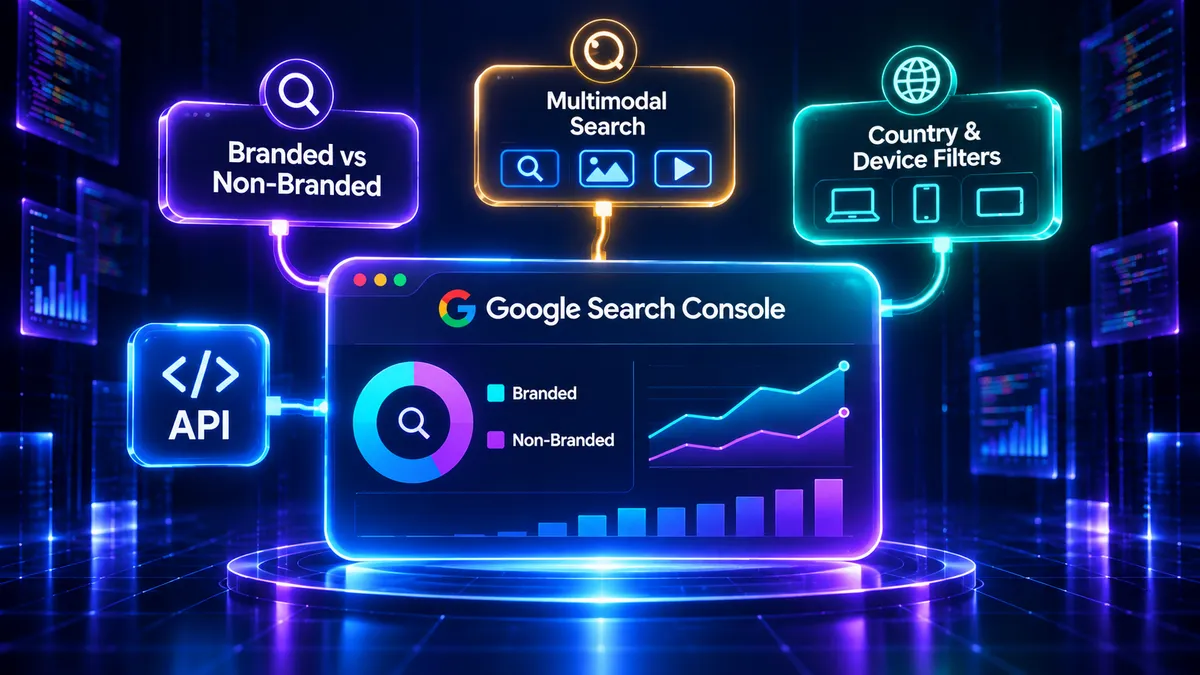
On 16 November, Google moved three existing Search Console reporting capabilities into the Search Analytics API:
- Brand split: group or filter eligible data with
brandedClassification. - Visual search: query
webMultimodalactivity, such as Google Lens, Circle to Search and image uploads to Google Search. - Fewer requests: use
filterListsto combine countries or devices in a single request.
Google says the data is also available in BigQuery for properties with an active bulk export.
Two caveats. Brand classification only works on eligible properties, so other properties may return no rows. And these are API additions, not a promise that any website will suddenly get significant new traffic.
Why a small team cares
Take an agency managing SEO for a regional furniture retailer. Clicks surge during a promotional campaign.
If that surge is mostly customers searching for the retailer's name, the acquisition story changes. Separating branded from non-branded queries keeps that conversation accurate. Multimodal data could also show how customers discover products through visual search.
The country and device filters cut repetitive extraction too. One request replaces a separate call for every market and device combination, so the pipeline has fewer moving parts. That makes the update commercially worthwhile even if traffic does not change.
Hype vs useful
A better dimension does not fix attribution:
- Brand and non-brand are Google's classifications, not yours.
- A rise in non-branded clicks still needs context from seasonality, landing pages and conversions.
- Search Console data has its own limits and is not complete website analytics.
The real win is a report that is more honest and less manual. Keep the historic totals, show eligibility clearly, and never treat unavailable data as a performance drop. A small dashboard people trust beats a long list of metrics nobody acts on.