A receptionist is not useful because it sounds human. It is useful when it captures a real customer request correctly, checks an actual calendar and either completes the booking or hands the call to someone who can. The gap between those jobs is where most voice automation projects become expensive.
What shipped
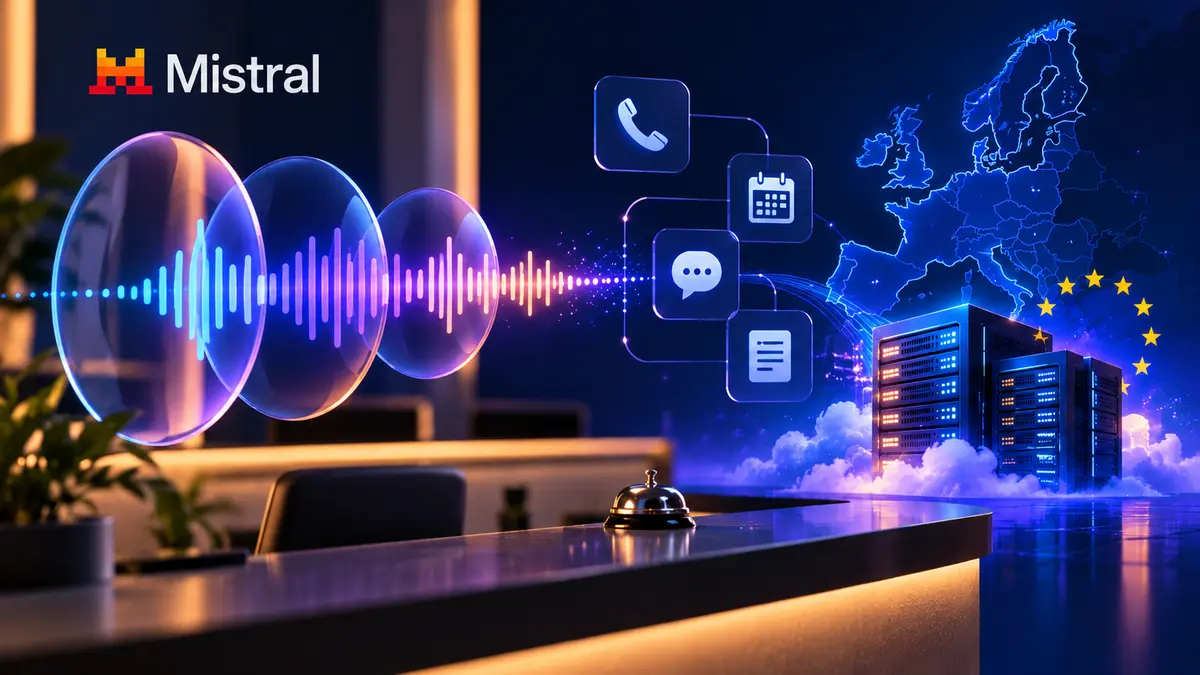
Mistral introduced Voxtral 3 on October 20, bringing speech-to-text, speech generation and a voice agent SDK into a streaming stack that can connect language models with tools. It is designed to work through browsers and phone systems, including workflows built with LiveKit. Mistral offers an EU-hosted API and the option to deploy components on a business's own infrastructure.
Mistral quotes a $0.04-per-minute option for a full voice agent using Mistral Small 4, or $0.08 per minute when using another model. Its published speech pricing includes batch transcription from $0.0035 per minute, realtime transcription at $0.008 per minute and generated speech at $13 per million characters. These figures are in US dollars, not a complete installed receptionist quote.
Audio routing, language selection, tool calling, conversation policies and logging still need implementation. Choosing an EU endpoint is useful, but a business must separately check where telephony providers, CRM integrations, logs and backups process personal data.
Why a small team cares
Consider a small Spanish physiotherapy clinic where staff are with patients for most of the day. A caller wants to move an appointment, ask about opening times or leave a callback request. A limited voice agent could answer routine questions and query the booking system when the clinic is closed. The value is fewer missed enquiries and less interruption during consultations, not a dramatic reduction in headcount.
The build needs a phone number or SIP provider, a speech pipeline, rules for what the agent may say, a booking-system integration and an escalation path. A careful first version should avoid clinical advice and confirm every proposed appointment change before writing it. Names, dates and telephone numbers are exactly the details to test under realistic noise and accents.
For EU callers, disclose clearly at the beginning of the interaction that they are speaking with AI. The EU AI Act includes transparency requirements for direct interaction with AI systems, and local privacy requirements still apply to recordings and personal information. The hosting region alone does not establish GDPR compliance.
Hype vs useful
Mistral publishes strong speech and voice benchmarks, but its comparisons are vendor-run and some involve AI-based evaluation. They are useful as signals for picking a candidate, not proof of performance on a clinic's booking calls.
A 100-minute month would cost roughly $4 at the quoted $0.04 agent rate before phone provider fees, implementation, hosting differences and any other services. That is cheap enough for a controlled trial, but it says almost nothing about the cost of a production service that must handle errors, outages and customer complaints.
I would measure completed requests without correction, failed calls, transfers to a person and total cost per successfully handled enquiry. If it cannot reliably manage ten realistic interactions and recover from missing information, an impressive demo voice is not enough to justify deployment.