What actually happened
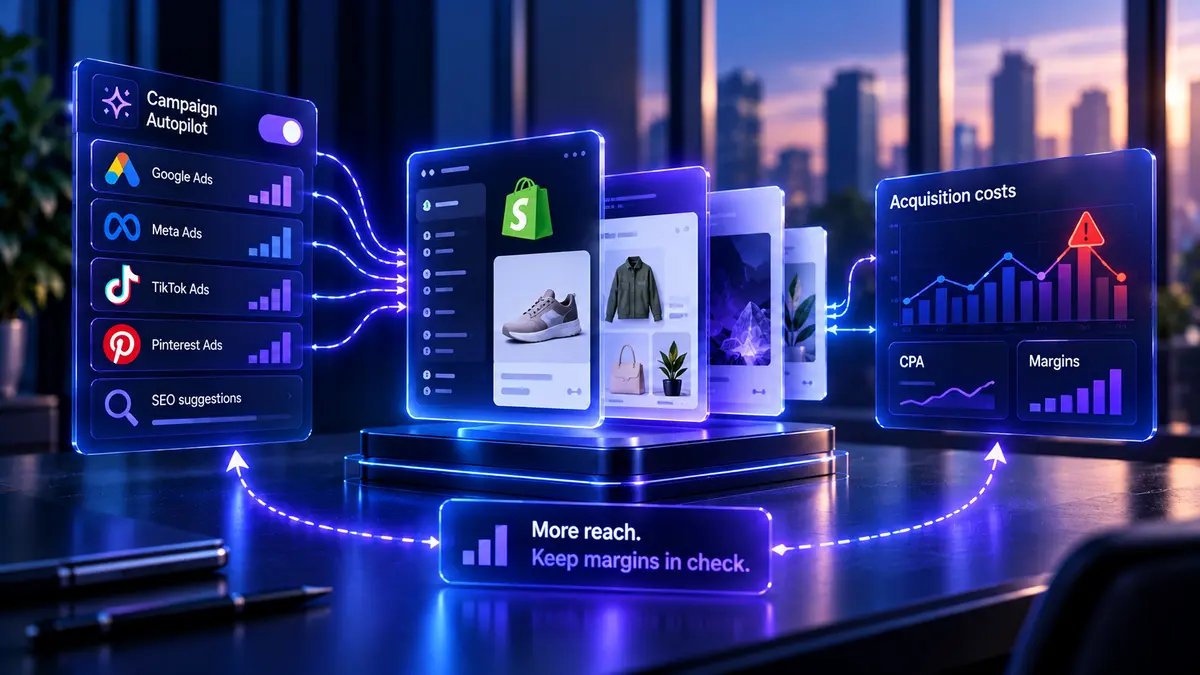
Shopify announced on October 28 that Campaign Autopilot is available to all merchants. It can use a store’s products, customer data and business context to build marketing campaigns and distribute budgets across Meta Ads, Microsoft Advertising, Snapchat, Shop and Shopify Messaging. Shopify says X Ads support is planned. The system can also recommend SEO changes for merchant approval.
The wider Fall 2026 commerce push includes tools for making store information available to AI shopping assistants. Merchants can maintain product details and supporting store facts, such as shipping and returns terms, that help an assistant present an offer accurately.
These are two different operational jobs: deciding where to buy traffic and ensuring AI-driven product discovery has usable information. Combining them into one announcement does not make them one experiment.
Why a small team cares
Take a small homeware store with limited time for campaign management. Moving budget between networks normally involves separate dashboards, creative requirements and reporting conventions. An automated system could reduce that administrative load if it delivers comparable or better customers at the same total cost.
But cross-channel automation makes it easy to lose sight of where spend actually went. A reported sale is not automatically an incremental sale, and a lower cost per purchase may still be unprofitable after delivery, discounts and returns. The store should measure new-customer acquisition against contribution margin.
AI shopping visibility creates another maintenance job. Incorrect delivery promises or stale return policies can damage conversion and trigger avoidable customer service. Accurate structured product facts are more valuable than speculative attempts to game assistant recommendations.
Hype vs useful
Shopify describes an automated system that reallocates budget toward what works. That is a product capability claim, not independent evidence of lower acquisition costs for a particular merchant. Campaign results remain sensitive to attribution settings, creative quality and seasonality.
The sensible opportunity is a bounded operational test, not switching off advertising oversight. I would treat AI shopping readiness as product-data hygiene and Autopilot as a paid-acquisition experiment. Neither deserves a large rollout until the economics hold up in the store’s own numbers.