What actually happened
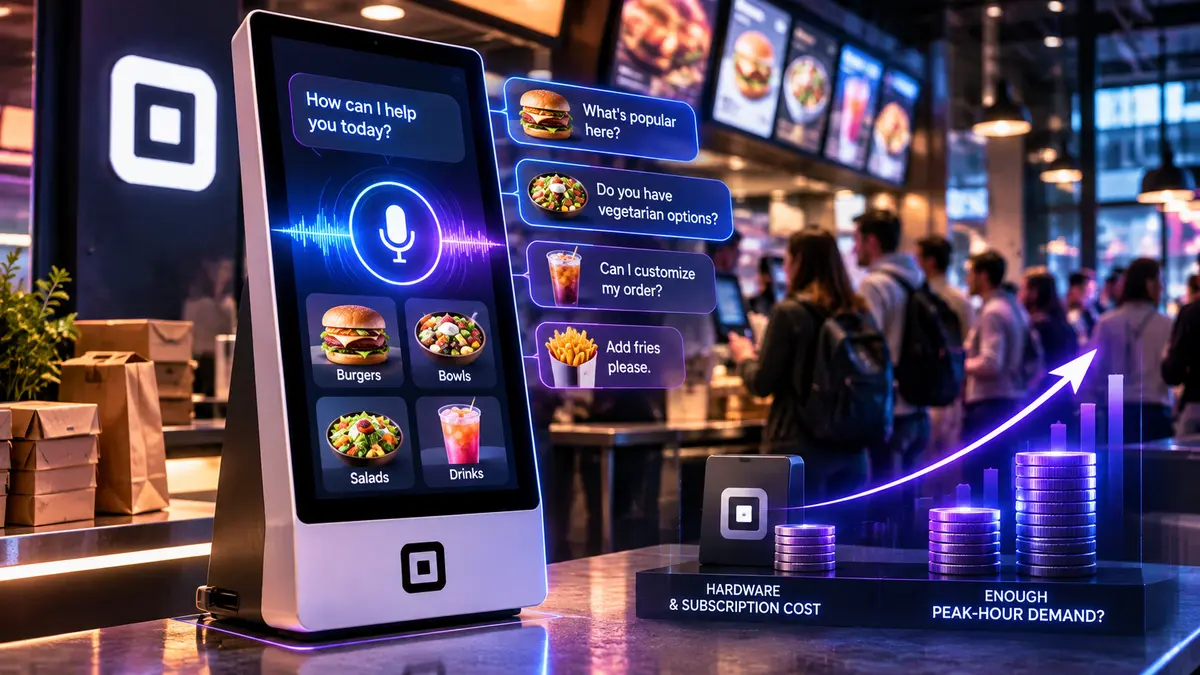
On 14 October 2026, Square unveiled a new self-service ordering kiosk for quick-service restaurants. It combines a 21.5-inch touchscreen with a conversational voice interface designed to understand a restaurant's menu. Customers can ask about dishes, request modifications and substitutions, and receive suggestions while ordering. Square positions the system as a way to relieve pressure at busy counters and improve order values. Those are the vendor's expectations, not demonstrated results for every independent restaurant.
US launch pricing starts at $1,999 for hardware with the counter stand, plus $99 per month per device for kiosk software. The device also requires Square Plus at $49 per location per month or Square Premium at $149, according to Square's launch announcement. Hardware pricing varies with the stand, and costs related to payments, staffing and operations must be considered separately. A restaurant outside the supported US offering should not assume the same price or availability.
Why a small team cares
Imagine a small takeaway restaurant whose lunch rush creates a queue while one employee splits attention between order-taking, packing and handing food to customers. A kiosk may help only if it processes orders that otherwise would have been delayed or lost, or lets that employee spend productive time elsewhere. An impressive voice demo has no financial value if most guests still order at the counter and the employee cannot take on other work.
Here is a simple illustrative calculation, not Square performance data. Amortize the $1,999 equipment over 24 months: roughly $83 a month. Add the $99 kiosk fee for an incremental fixed cost of about $182 per month, excluding payment fees, repairs and the existing Square subscription. At a hypothetical $15 per productive labor hour, the restaurant needs about 12.1 genuinely saved or redeployed hours monthly just to cover that incremental cost. That means about 28 minutes of useful work per operating day across 26 days.
If the business would need to buy Square Plus solely for the kiosk, the same simple monthly calculation increases to about $231, or 15.4 hours at the same labor rate. At a hypothetical contribution margin of $6 per extra order, the $182 incremental cost instead needs roughly 31 additional profitable orders a month. That is just over one incremental order per day across 26 operating days. These examples are break-even thresholds before other costs, not promised savings.
The missing variable is throughput. If the kitchen already operates at capacity, taking extra orders faster will not increase output. If customers do not want to speak with a kiosk, the new interface could add friction. If staff are still needed beside the kiosk to explain choices and fix exceptions, productive labor savings could be far below the headline expectation. Restaurants should measure peak congestion and completion rates before treating order count as a benefit.
Hype vs useful
AI can make self-service less rigid when a menu contains substitutions and questions that a conventional touchscreen handles poorly. But voice recognition in a noisy dining room, allergy information, language coverage and consistent modifier pricing all need direct testing. A recommendation that increases ticket size is beneficial only when the additional item has positive margin and does not slow the kitchen.
I would judge a pilot by order completion time, support interventions, average contribution margin, customer abandonment and net staff capacity. The best candidate is a high-volume quick-service operation with predictable products and a real peak-hour bottleneck. A small seated restaurant where personal service is central may have a very different result.
For owners outside the US, this announcement is a useful cost model rather than an immediate shopping recommendation. It demonstrates where conversational AI could fit into physical commerce, but local availability, integration costs and customer behavior decide the business case. Buying automation before locating the bottleneck is still an expensive way to discover that the queue was never the main problem.