A search fee can disappear while the cost of a research report stays the same. The bigger variable is often how much material the model reads before producing something useful.
What actually happened
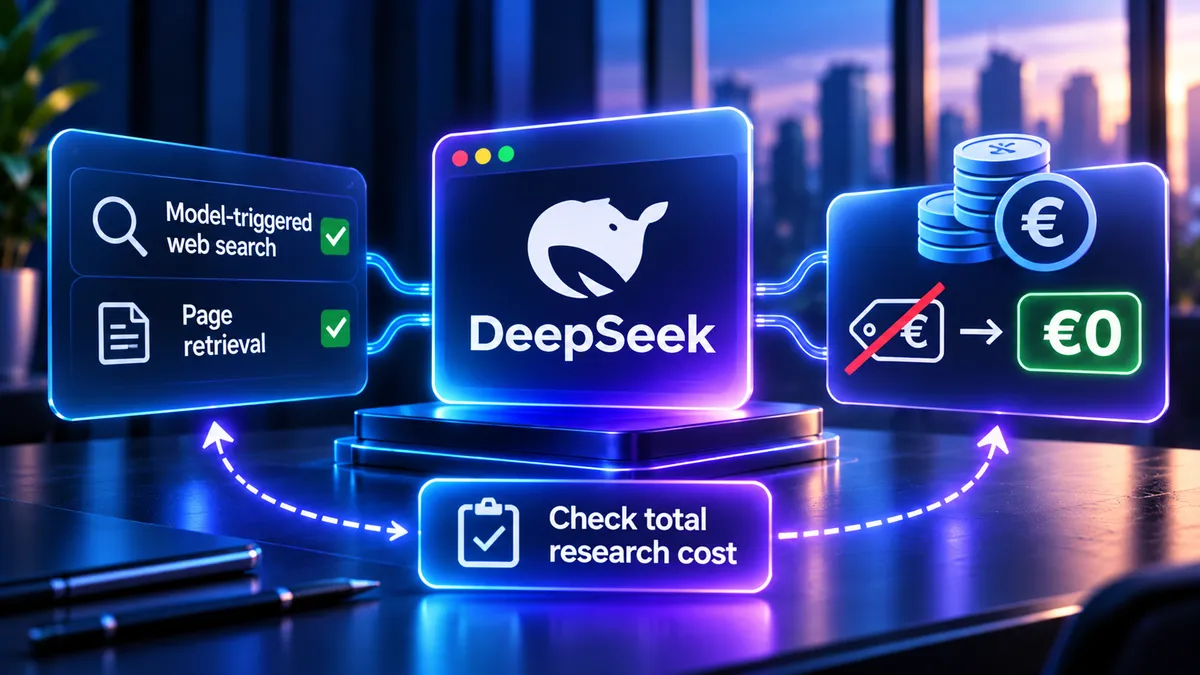
At 12:00 Beijing time on 18 November 2026, DeepSeek stopped charging separate per-call fees for supported web searches and page fetches initiated by its models through server-side tools. Retrieved information is still placed into the model context and charged at normal token rates.
This is not a free-for-all Search API. Standalone calls to DeepSeek's Search and Fetch endpoints still cost $0.75 per 1,000 successful requests each. The billing route depends on whether the model invokes a supported server-side web tool or your application calls a standalone endpoint directly. DeepSeek documents both paths.
Why a small team cares
Imagine a five-person agency generating short competitor research notes for client meetings. One brief may need two searches; another needs ten and several page reads. With model-directed tools, an agent can decide when another lookup is needed, and those particular tool calls no longer add their own line-item charge.
That can reduce overhead for variable-length research, but it also changes what to measure. If an agent retrieves 80,000 tokens to produce a one-page answer, free web calls are unlikely to be its decisive advantage. Source quality and time spent correcting the answer matter just as much.
A direct Search API still makes sense if your code needs predictable structured results for ranking, caching or auditing. At current published rates, 20 standalone search or fetch calls cost $0.015 before model usage. That is too small to justify rewriting a working system without evidence.
Hype vs useful
The vendor's pricing change is real; a lower total agent bill is not guaranteed. Model choice, token pricing, repeated retrievals and failure rate determine the result.
Compare the same research tasks using both routes. Count correctly completed outputs, review the cited pages and record total spend and duration. If the model-led version is accurate and cheaper per usable result, expand it. If it searches aimlessly, keep the existing workflow.