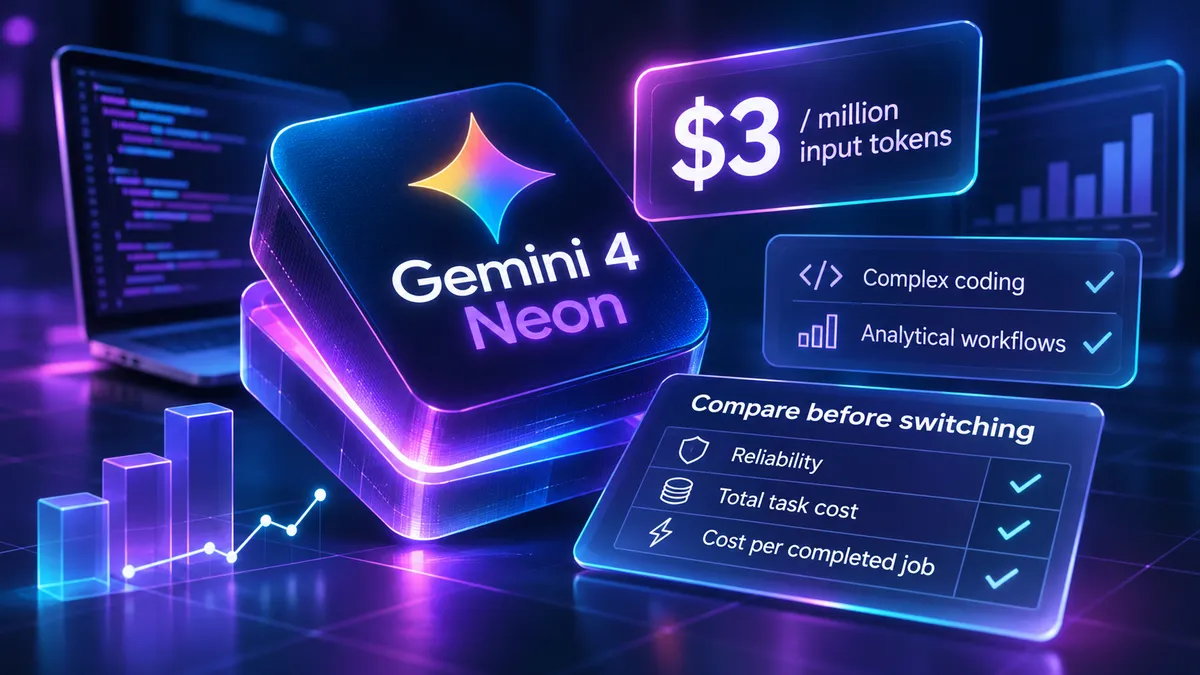
The cheapest token is not necessarily the cheapest completed job. For an automation that retries twice or needs manual repair, the invoice rate can hide the real cost.
What actually happened
Google introduced Gemini 4 Neon on 18 November for complex coding, reasoning and multi-step tool use. It is rolling out through the Gemini API and Google AI Studio, Gemini for business and paid access in Google Antigravity and the Gemini app. Google positions Neon as a fast, capable option for demanding workflows.
Published API rates are $3 per million input tokens, $0.15 for cached input tokens and $15 per million output tokens. The model offers a one-million-token context window and multimodal document, spreadsheet, chart, audio and video understanding. Google reports competitive results across coding and analytical evaluations, but those benchmarks do not establish the outcome of any particular team's workflow.
Why a small team cares
Consider an agency running an AI-assisted debugging workflow on several client applications. The agent reads repository files, investigates test failures, proposes changes and occasionally needs another attempt. Total cost includes prompt and output tokens, tool calls, execution time and a developer checking the patch. Lowering the unit price matters only when the completion rate remains acceptable.
Neon could be a sensible candidate for multi-file bug investigations and migrations that demand more reasoning than routine extraction or classification. It should not replace cheap and reliable models on straightforward tasks without evidence. Those jobs may already be close to their cost floor.
Long context also has a bill attached. Feeding an entire repository or many unfiltered documents into every run can be slower and more expensive than selectively retrieving the handful of files that matter.
Hype vs useful
Google's rankings describe performance under defined evaluation setups, some of which use specific agent harnesses or thinking levels. They are a useful signal for selecting test candidates, not a guarantee that Neon will be faster or cheaper in your application. Caching rates also apply only where requests actually qualify for caching.
The useful decision is whether Neon produces more accepted fixes with fewer retries or less human intervention. A task that succeeds on the first attempt at a slightly higher token bill may outperform one that needs repeated runs. Keep model routing simple: one default, one candidate for hard jobs and a clear fallback when validation fails.