AI coding assistants become more valuable when they can work from the system that actually contains the information, rather than a developer's copied and possibly outdated description of it. The price of that context is broader access, so scope matters more than the connector count.
What shipped
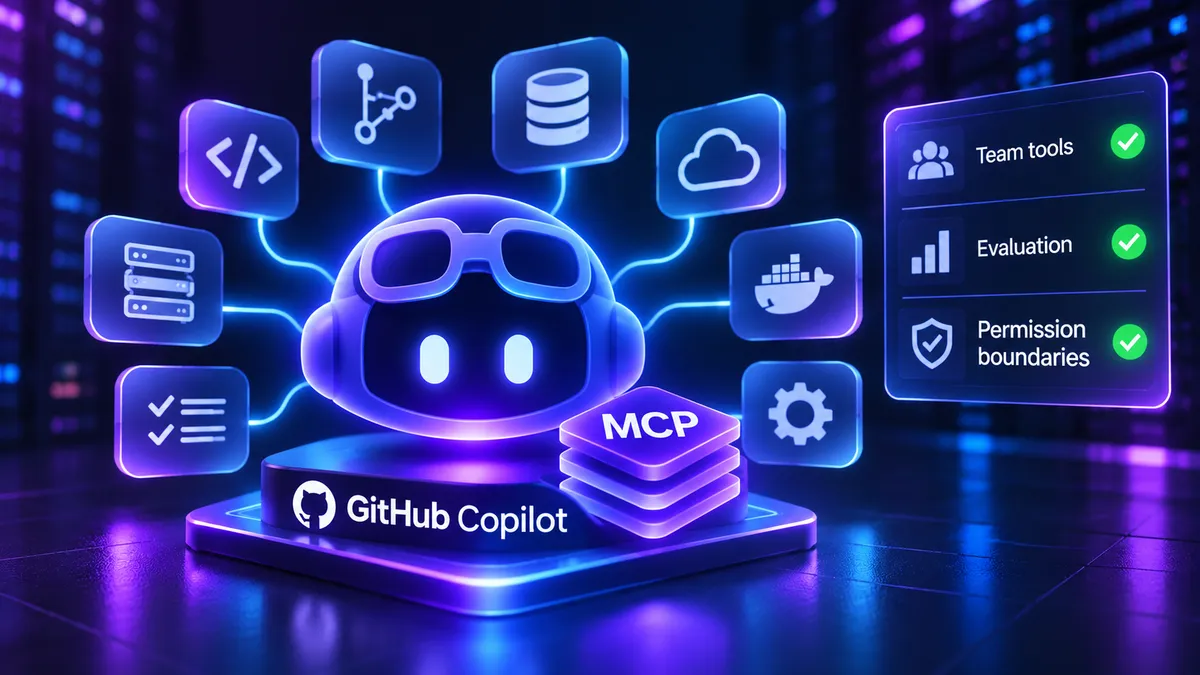
On 18 November, GitHub added eight verified Model Context Protocol connectors in public preview: Supabase, Mixpanel, Webflow, Wix, Calendly, ClickUp, Box and Buildkite. They join GitHub's existing connector catalog and can be configured through the Copilot app, Copilot CLI, VS Code or GitHub's customization interface. A connection established once can be used across supported Copilot surfaces.
The useful examples are specific. Copilot can inspect a Supabase schema before writing a migration, examine a Buildkite failure while fixing the corresponding code, or reference Mixpanel analytics while investigating a product issue. The model receives tool-backed context instead of depending only on pasted logs and database definitions.
GitHub also made team-level Copilot customizations available to eligible Business and Enterprise users. Team maintainers can share approved plugins and instructions with their members; organization policies override team-level choices. That gives a small engineering organization a way to maintain one common tool setup rather than relying on individual developers to configure everything.
Two other releases address the quality of the output. Copilot code review now offers Adaptive effort in public preview, choosing a review depth based on the complexity and risk of a pull request. Review-time secret detection is also in public preview. Separately, Copilot Evals lets developers define repeatable tasks for testing skills, agents and MCP tools, compare outcomes and inspect failures. Evals is itself in public preview.
Availability is not uniform. The eight connectors are in public preview across Copilot plans, but Business and Enterprise administrators must enable the editor preview feature policy and may need to approve particular connectors. Adaptive review has its own supported plan list and settings. A feature being announced does not mean it has been enabled automatically for every seat.
Why a small team cares
Picture a seven-person agency with a React application, Supabase backend and several client-facing integrations. A developer preparing a schema change traditionally needs to inspect the live table definitions, read migration history, understand the application queries, then translate all of that context into a request for an assistant. A connected assistant can reduce the copying and context-switching, provided it is pointed at the correct environment.
That is a meaningful improvement for the narrow job of preparing a migration proposal. It does not make the proposed migration safe to apply. The developer still needs to review affected rows, permission policies, locks and rollback options, and test against a staging database. In this case, read access can deliver most of the context benefit without permitting direct changes to production.
Build failures offer another contained test. Let the assistant read a failing Buildkite pipeline, identify a probable cause and prepare a candidate patch. Then compare the result with the developer's normal diagnostic process. The metric is not whether the agent wrote code; it is whether the build passes and the developer spent less time reaching a correct fix.
Shared plugins are useful when the same job recurs across the team. If every developer uses the same repository conventions, pull request checks and documentation sources, one team customization reduces setup drift. For a team with one Copilot user or widely different workflows, enforcing a shared set provides less value.
The evaluation update is arguably more significant than another connector. A model or prompt change may look excellent in one demo and fail on routine internal cases. An eval built around a handful of representative migrations, code reviews or debugging jobs can reveal regressions before they reach the team's default setup. It is not a substitute for tests, but it makes changing agent behavior less arbitrary.
Hype vs useful
Connected agents introduce two practical failure modes. First, an assistant might act on the wrong environment, using production data when the intention was to inspect staging. Second, retrieved information from external tools can contain misleading or malicious instructions. Administrators should grant the minimum service permissions, restrict write actions and ensure any consequential change passes through an ordinary review process.
More plugins are not automatically better. Each connector expands the information the assistant can encounter and the actions it might be permitted to take. A catalog of thirty integrations is irrelevant if the engineering bottleneck is an unstable test suite or ambiguous product requirements.
Adaptive code review has a similar boundary. It may select deeper scrutiny for risky changes, but a generated review cannot prove that access controls, billing logic or migrations behave correctly in production. The effective loop remains proposal, automated checks, human review and a controlled release.
The practical case for Copilot is getting stronger for organizations already using it, especially where development work depends on context stored in several tools. The right decision this week is still a controlled test: one connector, one job, measured outcome and explicit permission limits. Standardize only what survives that trial.