Finding out which repository contains a live production key should not depend on someone remembering to run a security scan. For small software teams, the real benefit is a repeatable view of exposure.
What actually happened
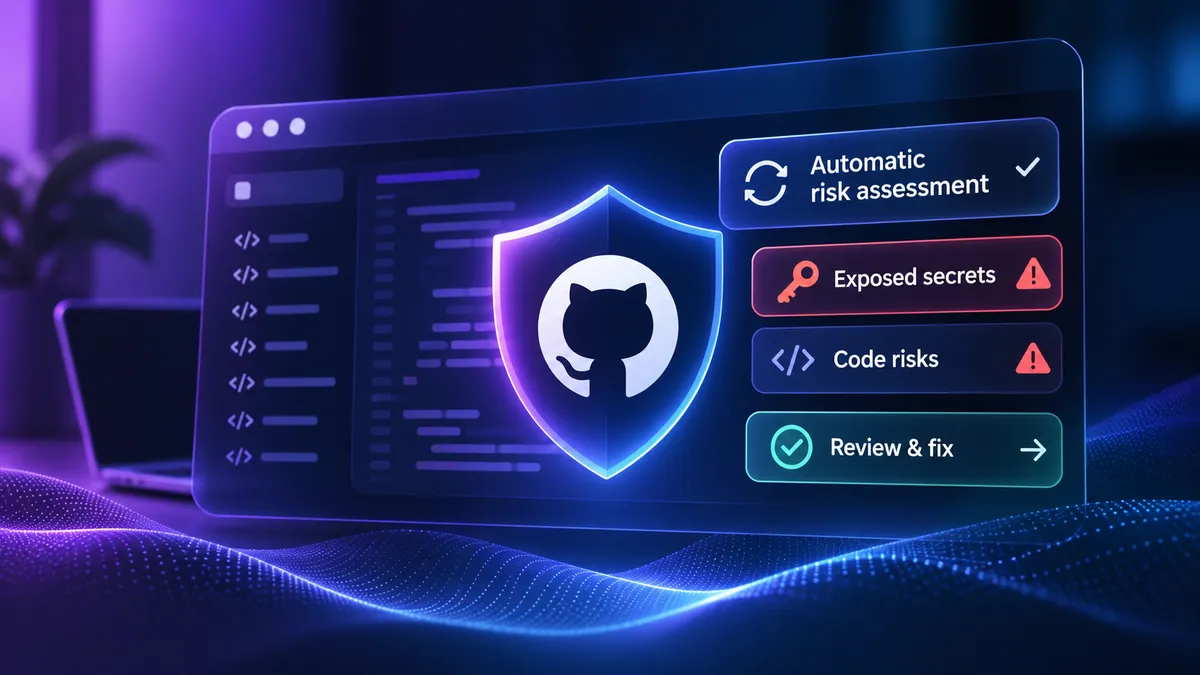
On 18 November, GitHub said security risk assessments now run automatically for organizations on GitHub Team. Organization administrators and security managers can inspect the free findings, which cover exposed credentials and vulnerabilities in code. The change removes the need to start these assessments manually.
The update does not mean all GitHub security products are suddenly included in the Team plan. It concerns these risk assessments and the access to their findings, not a promise of unrestricted advanced scanning, remediation or continuous incident response.
Why a small team cares
Consider a six-person web development agency maintaining client sites, internal tools and several deployment scripts. Credentials are distributed across repositories, CI jobs and integrations. Every new project creates another chance for a token to be committed or an application weakness to remain unnoticed. An automatic assessment gives the agency a recurring starting point without adding another administrative task.
The important distinction is exposure versus inconvenience. A compromised production database credential can justify immediate investigation and rotation. A code finding in a retired prototype usually does not deserve the same urgency. The value comes from a responsible person ranking results by what is deployed, reachable and business-critical.
AI coding agents increase the volume of code and configuration changes that teams need to inspect. These assessments can catch some problems in that output, but they do not transfer accountability away from the developer reviewing the change.
Hype vs useful
An automated assessment is not a penetration test. It may miss application-level problems, insecure authorization flows and weaknesses in environments that repository analysis cannot see. Some alerts will also need validation before they justify operational disruption.
Still, the default is straightforward for existing GitHub Team customers. Use the new automatic baseline, connect the results to actual remediation ownership, and keep branch review, dependency management, access control and production monitoring in place. Free detection only saves money when someone acts on the important findings.