What shipped
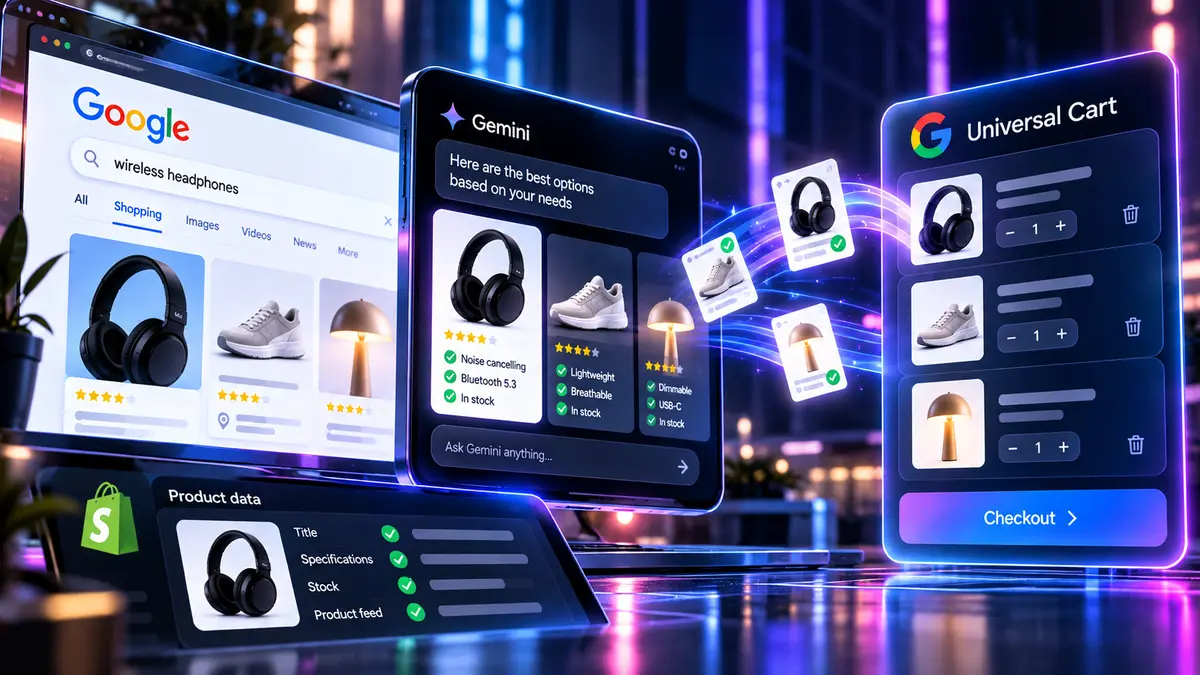
Google launched Universal Cart in the United States on 15 October 2026, after previewing the product earlier in the year. Available across Google Search and the Gemini app, it lets shoppers save items from different retailers into one shopping cart, monitor price and stock changes, discover promotional offers and review potential payment-method benefits. Supported purchases can be completed using Google Pay or passed to the merchant's site. Google says the merchant remains the seller of record and handles confirmation and support.
This is a US consumer launch, not an announcement that every retailer in Spain can immediately enroll in a new checkout program. Google names several participating retailers and many Shopify merchants, but the announcement does not provide a universal merchant-eligibility checklist or promise access for all stores. Its immediate significance for smaller European merchants is the direction of product discovery and checkout rather than a feature to switch on today.
Why a small team cares
Imagine a specialist Shopify shop selling ergonomic home-office furniture. A customer compares desks and chairs from several retailers while asking Gemini for a setup that fits a small room. Once the shopping journey starts inside a shared cart, individual merchants have less control over when shoppers open their sites. Accurate catalog information becomes more influential during the selection process.
A €399 adjustable desk with only a product title and a photograph leaves practical questions unanswered. A comparable listing with dimensions, minimum and maximum height, shipping coverage, warranty, assembly information and current stock gives the shopper and product-discovery systems more reliable facts. Better metadata cannot guarantee recommendation or ranking, but it can remove ambiguity that would otherwise prevent a confident purchase.
That work has commercial value beyond AI shopping. Correct attributes reduce product-support questions, eliminate misleading delivery expectations and improve filtering across ordinary search and shopping feeds. For a 100-product catalog, the manageable opportunity is fixing inconsistent and missing information, not buying an expensive agentic-commerce platform.
Hype vs useful
Universal Cart is a genuine shopping experience, but its launch does not prove that AI automatically sells products for small merchants or that adding Product schema produces inclusion. Merchant eligibility, Google Shopping data requirements, payment support and the eventual rollout outside the US are separate questions. Sellers should not promise AI-generated revenue before they can see actual impressions, traffic and orders.
Start from the catalog's existing business problems: wrong prices, missing specifications, out-of-date availability and mismatched feed data. A limited product-data quality test is cheap to maintain and gives measurable outputs such as the percentage of attributes corrected and validation errors removed. If a merchant already uses Google Merchant Center and Shopify, its current feeds and product pages provide a sensible baseline. The payoff should first be better product accuracy, with AI shopping distribution treated as an opportunity to evaluate when access and reporting are confirmed.