The cheapest model on a rate card can become the expensive option once failed attempts, tool calls and code review enter the equation. That is the useful lens for OpenAI's 17 November model release.
What actually happened
OpenAI released GPT-6.2 Astra for demanding professional work and GPT-6.2 Sol for everyday work and multistep agents. Both are available through the API and, for eligible users, ChatGPT Work and Codex. The models have different price points and are intended for different workloads.
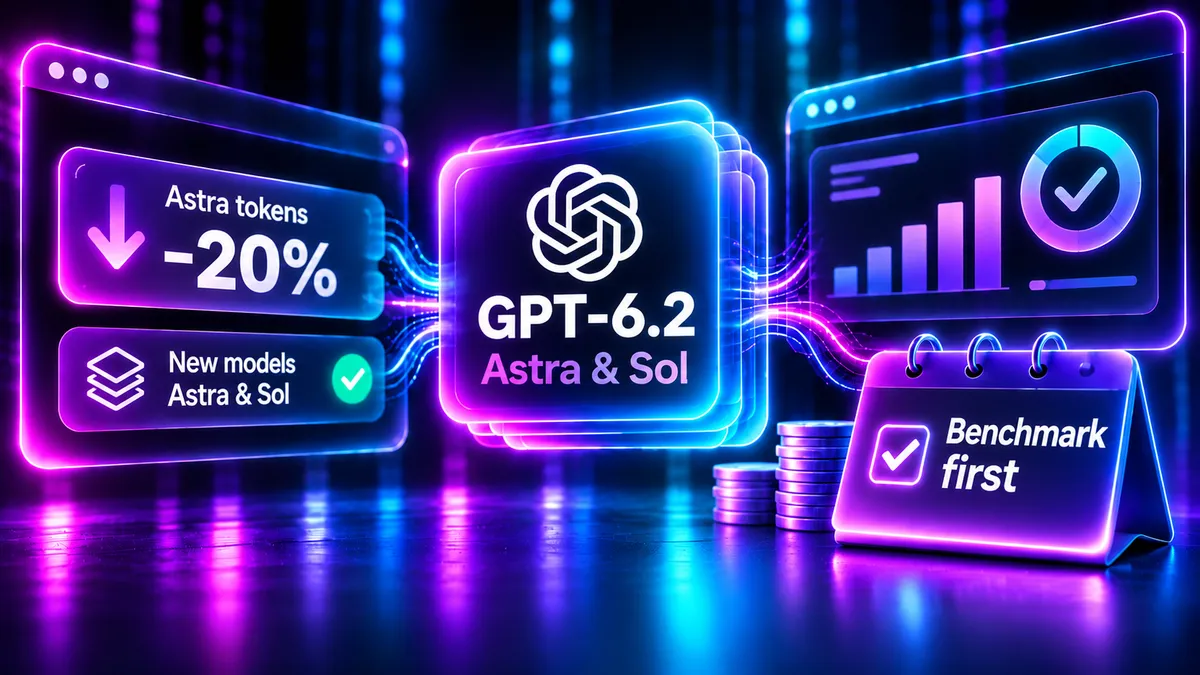
GPT-6.2 Sol costs $2 per million input tokens and $10 per million output tokens, unchanged from GPT-6.1 Sol. Astra costs $8 per million input tokens and $40 per million output tokens, 20% below the corresponding GPT-6 Astra standard rates. Cached input costs $0.10 per million tokens for Sol and $0.40 for Astra. OpenAI claims improved quality and fewer output tokens on demanding jobs.
Why a small team cares
Consider a small agency using a coding agent to implement changes across client projects. One ticket may take several attempts before tests pass and the diff meets review standards. A stronger model can cost more for one inference yet still consume fewer total tokens, retries and engineer minutes.
That means a clean benchmark has to include both machine charges and human work. Track accepted pull requests or validated outputs, not merely token totals. The same logic applies to document extraction and classification, where a cheap but error-prone answer adds correction work downstream.
Hype vs useful
OpenAI's benchmark results are vendor-reported and do not establish that your repository or automation will see the same gains. A model upgrade can alter formatting, tool-use decisions and latency, so replacing a production default without regression testing is avoidable risk.
Sol is a reasonable first candidate for routine jobs, while Astra should compete for complex debugging and difficult reasoning. Keep the current model as the baseline and judge both by correctly completed tasks and total cost, including review. A higher benchmark score is not by itself a business case.