Three model announcements in one week sound like another leaderboard race. For a small development team, the useful question is narrower: can any of them complete real work with less cost, less data exposure or less supervision?
What actually happened
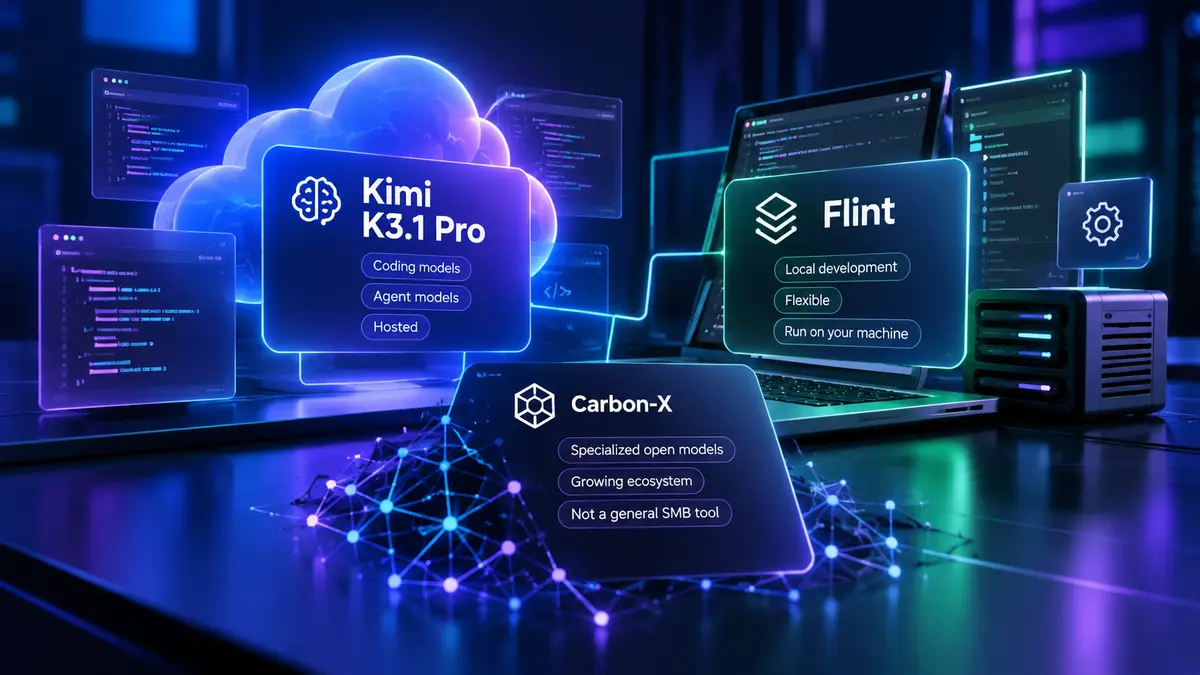
Moonshot introduced Kimi K3.1 Pro on October 23, with a one-million-token context window and a Highspeed variant it says is two to three times faster. The company claims competitive coding and agent performance against leading proprietary models. Its API is available now, but the model weights are promised by November 4, so 'open' should not yet be confused with a downloadable self-hosted checkpoint.
Recursive released Flint on October 21 under Apache 2.0. It is a roughly 40-billion-parameter mixture-of-experts coding model that activates about 2.5 billion parameters per token. Recursive reports 74.2% on SWE-bench Verified and offers quantized variants for local inference. Hugging Face also introduced Carbon-X, a 14.8-billion-parameter model trained on both genomic sequences and natural language. It serves a specialized research problem rather than everyday app development.
Why a small team cares
Consider a three-person team maintaining customer websites and internal integrations. A common coding task is adding regression tests after fixing an API failure. Running a quantized local assistant on an adequately equipped laptop could keep client code on-device and avoid per-token API charges for routine tasks. The trade-off is compute, setup and the time spent reviewing generated changes.
Flint's full-precision checkpoint is about 80 GB, so the headline that it 'runs on a laptop' refers to optimized or quantized deployments with sufficient RAM, not any ordinary office notebook. Its reported performance also depends on specific test harnesses and configurations. Kimi may be attractive for complex remote-agent tasks, but moving an entire workflow to a freshly announced model would produce more uncertainty than useful evidence.
Carbon-X illustrates a different kind of progress: an open, targeted research model can serve a narrow domain without sending sensitive data to a general chatbot. Its model card expressly warns that it has not been clinically validated. That makes it interesting technology but not a recommendation for a normal software agency to install.
Hype vs useful
Both Moonshot and Recursive publish impressive benchmark claims. Those scores are not equivalent to accepted production pull requests, and differences in harnesses, task selection, hardware and tool access can change outcomes. Carbon-X's scientific benchmark and cost comparisons are even less transferable to software delivery.
The useful comparison is one ticket with clear acceptance tests, measured against the tool already in use. If Flint needs more prompting and repair work than it saves in fees, local inference is not economically better. If it reliably handles a narrow slice of repeatable coding tasks, it may be worth adding without replacing the team's main assistant.