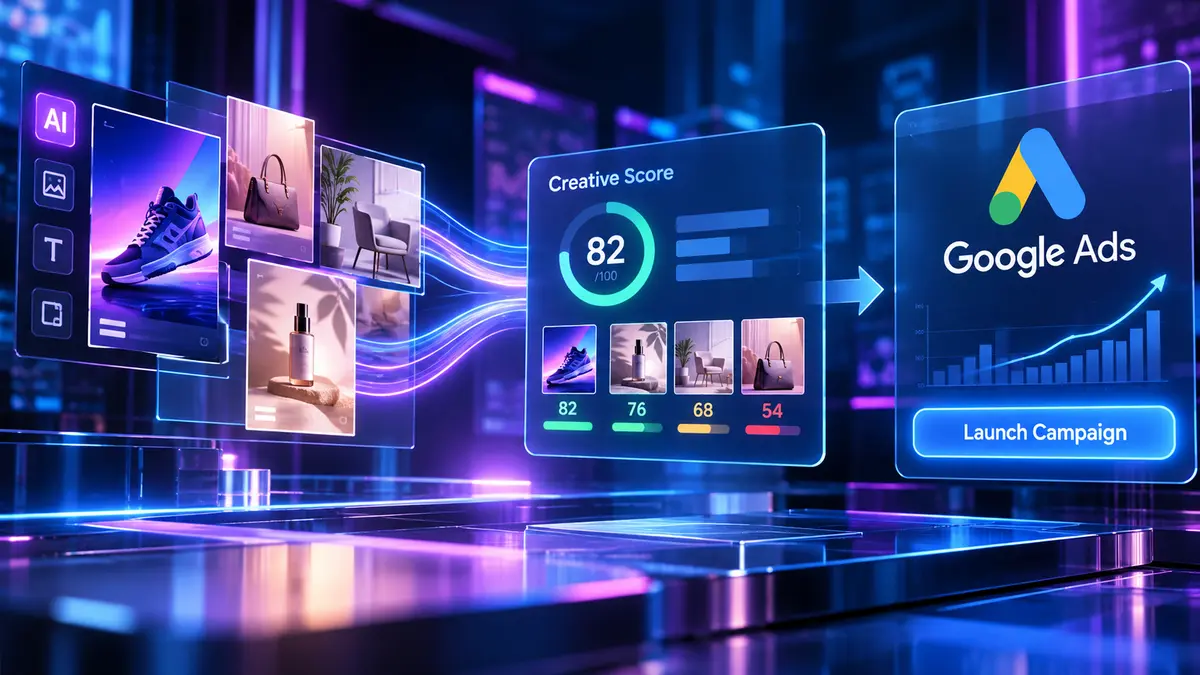
A product ad can be easy to generate and still expensive to get right. The costly part for a small advertiser is often the chain of handoffs: draft a concept, produce usable variations, put them into Google Ads, then work out which creative actually helped sales.
What actually happened
Picsart launched Marketing Studio on October 21, combining campaign planning, AI-generated creative, predictive testing and Google Ads campaign launch in one interface. Its product page confirms that advertisers can set budgets and targeting, review campaign settings, and approve the launch. Google Ads is supported now; Meta and TikTok campaign launches are listed as coming soon.
The creative testing layer uses Zappi consumer insights to score concepts and suggest changes before spend begins. After launch, Picsart says advertisers can read performance reports in plain language and use those results to develop new creative. The product connects production and campaign feedback, although the actual usefulness of that connection still needs testing.
Why a small team cares
Consider a small online shop selling specialty coffee. A weekend promotion might need three different angles: convenience, flavor and a starter bundle. The owner can generate visual and video variations, select a few candidates, and send the approved versions into a Google Ads campaign without exporting assets through several separate applications.
That saves money only if the resulting ads are usable and the campaign setup remains accurate. Faster creative production is a genuine improvement when it means fewer editing hours and more useful experiments. It is not an improvement if the shop then spends extra time correcting product images, false discount claims or mismatched landing pages.
The stronger opportunity is learning from real performance. If one message consistently attracts profitable orders rather than cheap clicks, the next round of ads can focus on that angle. The useful feedback is conversion value and customer acquisition cost, not merely a score that predicts what consumers might like.
Hype vs useful
Picsart presents Zappi-backed scoring as a way to pick stronger creative before launch. That is a vendor-backed prediction, not evidence of higher return on ad spend for a particular shop. Models cannot know a merchant's margins, tracking quality, inventory constraints or the conversion rate of its checkout.
There is also a difference between an AI-suggested campaign strategy and an acceptable media plan. Automated targeting and budget proposals deserve the same checks as recommendations from a human freelancer. The account owner remains responsible for spend, conversion measurement and accuracy of the offer.
I would judge this product by the time needed to reach three approved ads and by what happens once those ads run under normal campaign controls. If it removes production friction without reducing creative quality or campaign visibility, it could earn a place alongside the existing Google Ads workflow. If the output is generic or reporting lacks the detail needed to make decisions, keeping the tools separate is the better option.