The economics of AI automation get decided by the whole workflow. A model that is cheap on paper can be expensive if a failed classification creates a second API call, a broken CRM record or a manual support ticket.
What shipped
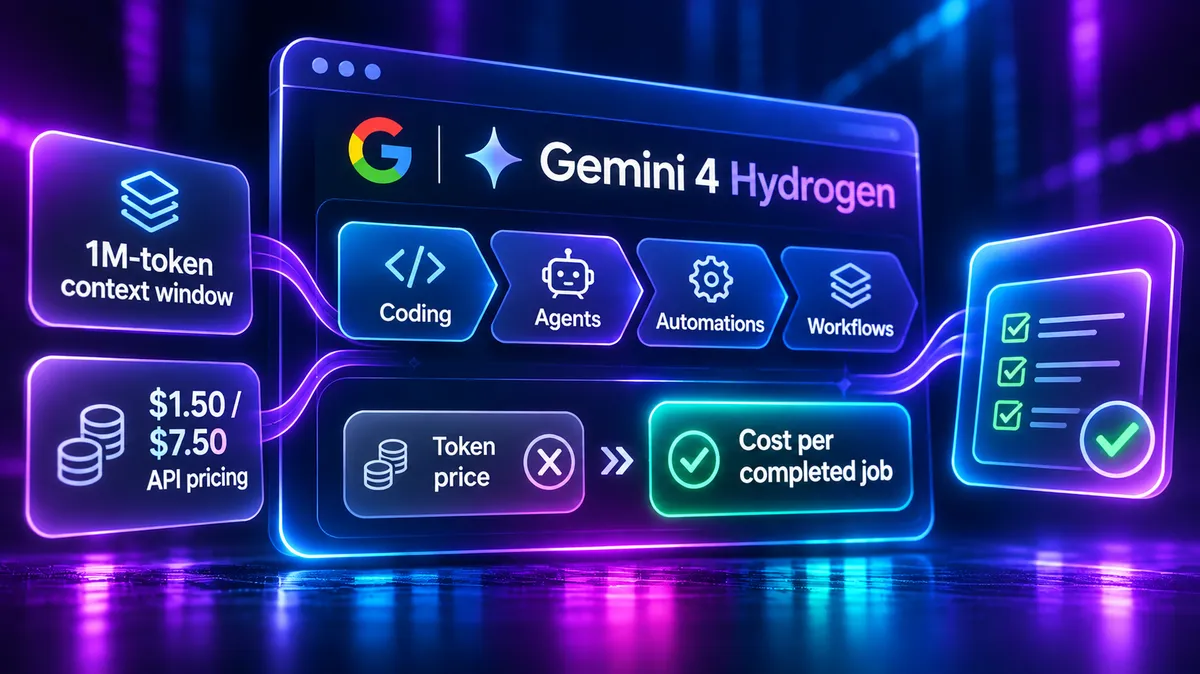
On November 12, Google released Gemini 4 Hydrogen as an efficient option for everyday coding and agent execution. It is available through the Gemini API and AI Studio, among other Google products. The model supports a one-million-token context window and configurable reasoning levels. Google's published standard paid API rate is $1.50 per million input tokens and $7.50 per million output tokens across that window.
Google positions Hydrogen as a faster execution model that can handle tool use, coding changes and repeated agent tasks, including work that may be coordinated by larger Gemini models. That positioning is a vendor claim, not a guarantee for your own tool definitions, prompts or production data.
Why a small team cares
Take a support operation processing 10,000 customer enquiries a month. Assume each case consumes 3,000 input tokens and 1,000 output tokens for a successful pass. At Google's standard rate, that example totals $120 in inference before retries, caching, infrastructure and any additional model calls. That is a budget estimate, not an expected bill for every helpdesk.
A small team might use a model to classify a request, retrieve relevant order context and prepare a draft reply. If Hydrogen follows the schema and chooses the right tool reliably, savings can add up over thousands of cases. If one in ten requests needs manual repair, the advertised token rate becomes less interesting than the added operating time.
Hype vs useful
A one-million-token context window does not mean you should send an entire customer database with every enquiry. Longer prompts cost money, increase latency and expose the model to unnecessary material. Likewise, public coding benchmarks do not establish that this model will update your CRM correctly.
Keep a representative benchmark set with normal cases, malformed inputs, unusual language and tool failures. Score successful business outcomes, not just syntactically valid JSON. Compare total API spend and the human time required to fix bad outputs. Only promote Hydrogen to production once the measured savings survive that test.