What shipped
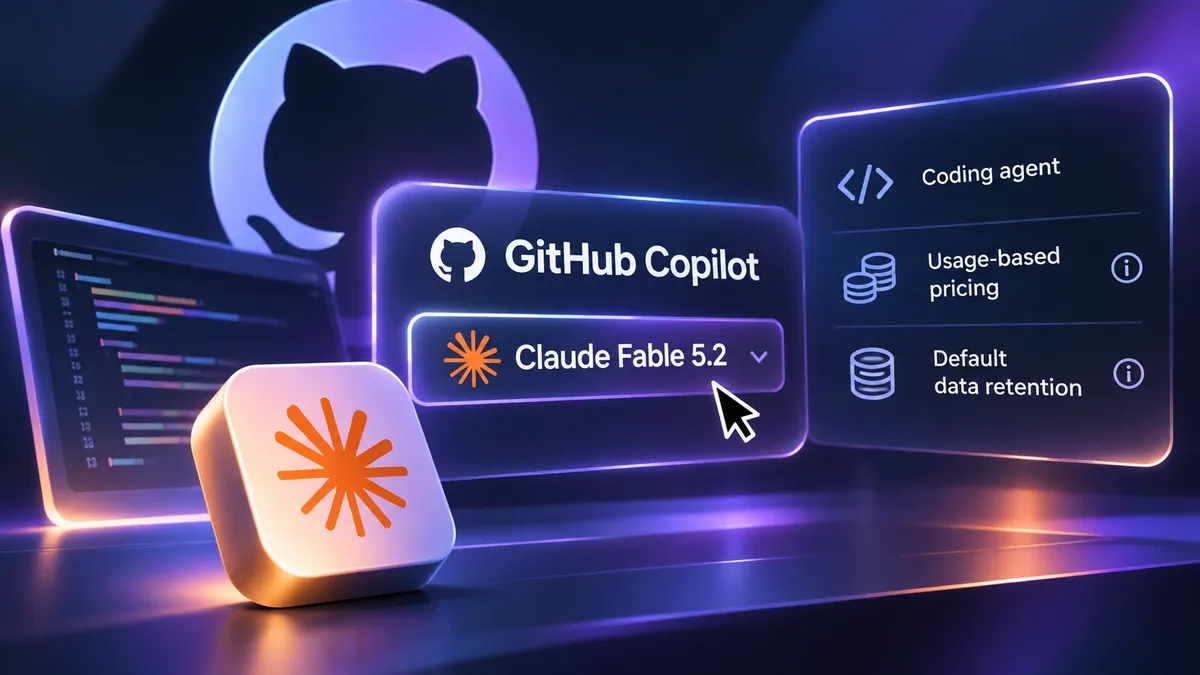
GitHub added Claude Fable 5.2 to Copilot on 9 November. The model is appearing in the picker across supported development environments, Copilot CLI, GitHub's coding agent and github.com. GitHub lists Pro+, Max, Business and Enterprise as eligible plans, with a gradual rollout. Business and Enterprise administrators must enable a separate Fable 5.2 policy, which starts disabled.
GitHub reports that Fable completed more complicated tasks with fewer tool calls than its predecessor in early testing. More consequential for a purchasing decision, Fable is billed at provider list prices through usage-based billing. This is not simply a free upgrade to every Copilot plan or an included allocation with identical economics to existing models.
Why a small team cares
A small agency could send a difficult integration pull request to the Copilot coding agent and compare the result with what its current model produces. The important measure is the accepted change: whether it passes the test suite, handles failure states and needs less human rework. A faster first answer is not useful if review and fixes take longer.
There is also a data decision before the test. GitHub says Anthropic retains prompts and outputs by default to operate safety classifiers for Fable models, and that retained data is not used to train Anthropic models. A temporary zero-retention exemption exists for certain eligible enterprise customers, but teams should not assume their normal Copilot data setting covers this model.
Hype vs useful
This launch is a distribution change, not a separate improvement to Fable itself. The underlying technical model is the same one Anthropic announced. You gain a convenient way to try it inside an existing development workflow, subject to plan, policy, rollout and billing restrictions. None of those automatically proves it should become your default coding model.
An experiment only needs one hard, representative PR and a clear comparison against the team's existing model. Include review time and billing, not just tokens or model claims. If the current model produces the same accepted result for less money and less governance overhead, keep it. This release should reduce tool-switching friction, not create an uncontrolled new line item.