What actually happened
OpenAI introduced GPT-6.1 Terra on October 26, 2026, with direct access through the API under the model ID gpt-6.1-terra. It also began rolling out through ChatGPT Work and Codex. The standard API rates are $1 per million input tokens, $0.05 for cached input and $5 for output, all billed separately from ChatGPT subscriptions.
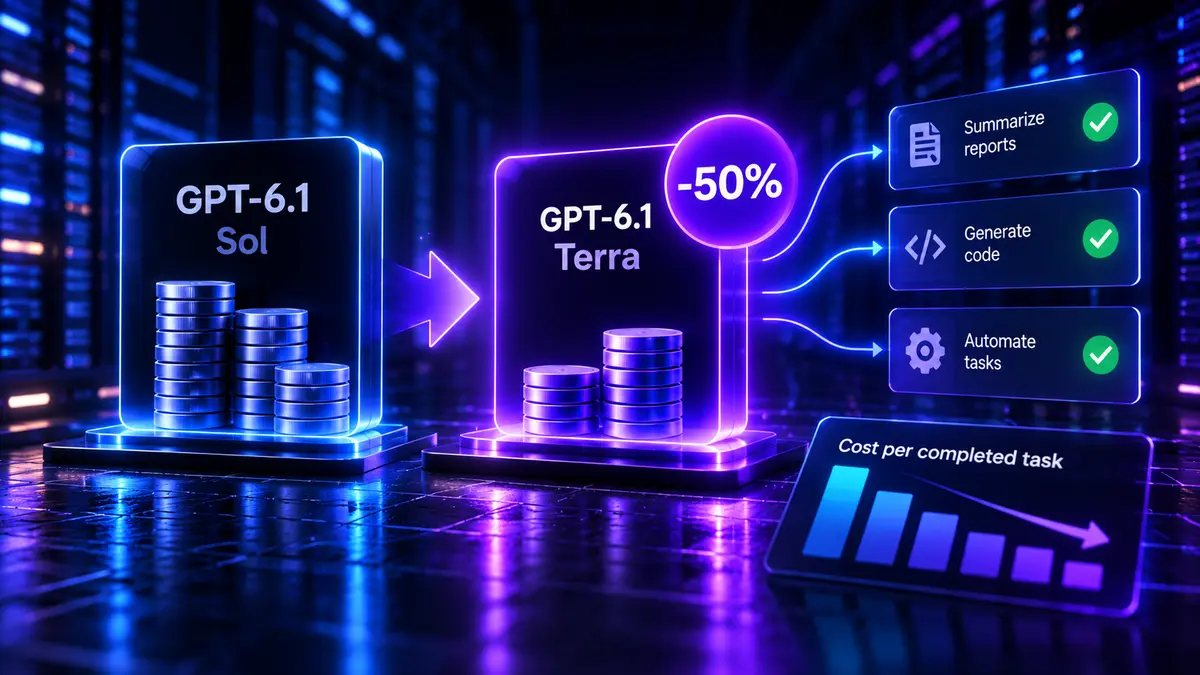
OpenAI says those standard token prices are 50% below GPT-5.6 Terra and GPT-6.1 Sol. The model focuses on visual understanding, precise computer interaction, writing and everyday software work. It supports tool calling through the Responses API, making it relevant to agents that operate across applications.
Why a small team cares
Consider a solo bookkeeper processing incoming invoice PDFs into an accounting system. Each record requires extraction, cross-checking against the supplier and perhaps interaction with an application screen. At meaningful monthly volume, the cost of the model can become a line item. Reducing the price per token creates room to process more documents or use an additional verification pass.
But output volume, tool calls, retries and human review can easily erase nominal savings. A model that costs half as much per token but needs twice as many attempts delivers no meaningful reduction. The useful unit is the cost per correctly posted and checked invoice, including the time spent handling exceptions.
Hype vs useful
OpenAI's benchmark claims are useful signals, not proof that Terra will outperform a model on your documents. Coding quality also depends on task complexity; OpenAI itself positions Sol and Astra above Terra for its most demanding development tasks.
The release is commercially relevant because it gives teams another reasonably priced option for production automation without changing vendors. Keep a stronger model for unusual cases if Terra struggles. One bounded workflow comparison is enough to decide whether the lower tariff produces a measurable operational saving.