What actually happened
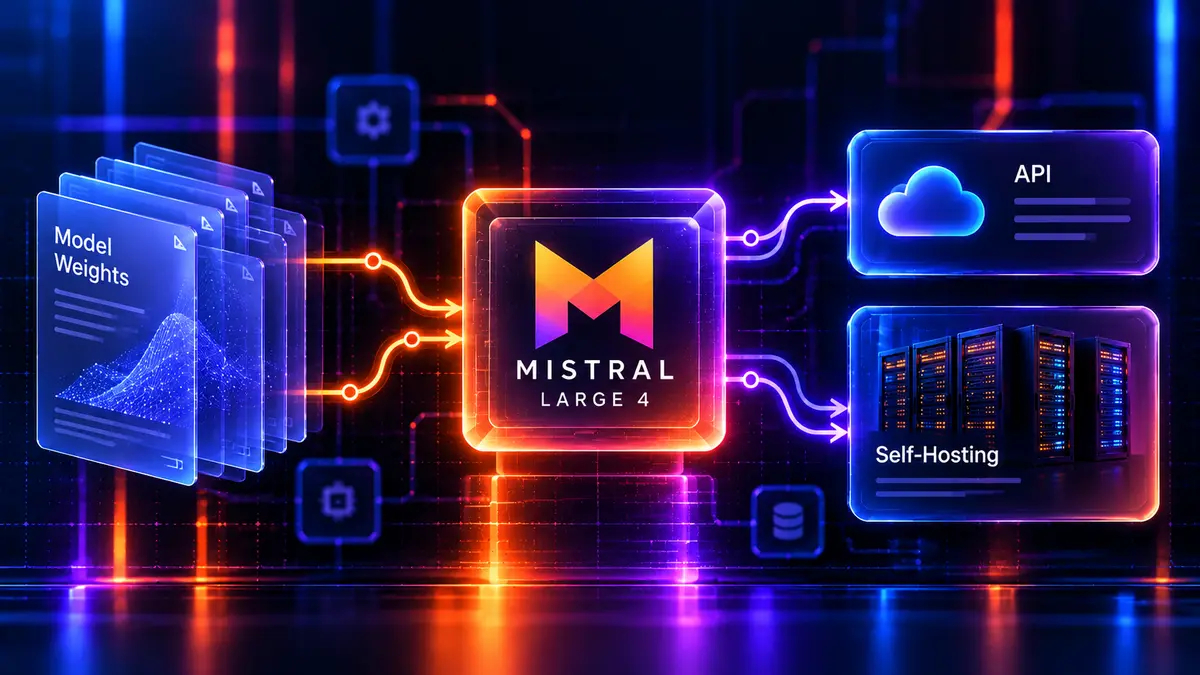
Mistral Large 4 entered public API preview on October 6. On October 29 its model weights became publicly available through Hugging Face, including FP8 and NVFP4 versions. The mixture-of-experts model has roughly one trillion total parameters, with a much smaller subset active during each token generation step.
Large 4 takes text and images as input, supports a long context window and targets reasoning, coding and security tasks. Mistral publishes API prices of $0.70 per million input tokens, $0.07 per million cached input tokens and $2.10 per million output tokens in its model documentation.
The weights use Mistral's Ecosystem Open-Weight License. Internal commercial use is permitted, while businesses providing the model itself as a paid hosted service need to examine separate licensing requirements. Open weights provide deployment options; they do not automatically make inference free.
Why a small team cares
Imagine a small software consultancy using AI to review pull requests, extract information from client PDFs and draft test cases. Token price matters because those tasks repeat, but output quality and correction time can erase any apparent saving.
A model that costs less for the first response but needs multiple retries is often more expensive per finished job. A sensible comparison uses the same input examples, consistent success criteria and the fully loaded cost of corrections, rather than relying on vendor-published rankings.
The open-weight release is relevant for organizations needing tighter deployment control. Yet this is not a model to casually run on an office laptop. Even lower-precision variants demand serious infrastructure, operational knowledge and monitoring. For most small teams, the hosted API is the realistic experiment.
Hype vs useful
Mistral presents Large 4 as competitive in coding and cybersecurity. Those claims deserve testing against a company's own work, where file formats, prompts and failure costs vary more than benchmark examples suggest. A public model download is also not a ready-made private AI system.
The useful development is choice. There is another capable model endpoint to benchmark, plus a route to controlled deployment for organizations with a concrete reason to pay for it. Start with the API and a fixed batch of real tasks. Keep the current provider unless Large 4 measurably improves quality, cost or both.